Introduction
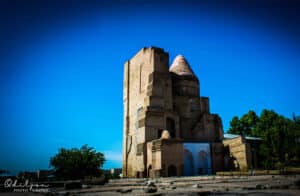
In the heart of Shahrisabz, the birthplace of Amir Temur (Tamerlane), rise the awe-inspiring ruins of the Ak-Saray Palace, once the most ambitious architectural project of Central Asia. Commissioned by the conqueror himself in the late 14th century, this “White Palace” stood as a statement of power, grandeur, and cultural brilliance. Though only fragments remain today, the legacy of Ak-Saray continues to captivate visitors from around the world.
A Palace Born from Empire
Following his conquests across Persia, India, and the Middle East, Amir Temur envisioned a palace in his hometown of Kesh (later renamed Shahrisabz, or “Green City”). He ordered the construction of a residence that would surpass anything built before it—”a palace worthy of kings from every corner of the world.”
Construction began in 1380 with an army of over 50,000 craftsmen and prisoners of war. Architects came from Bukhara, Samarkand, Urgench, Shiraz, Baghdad, and even further afield. Entire workshops were erected on the banks of the local river, where lapis lazuli from Badakhshan, marble from Kitab, and jade from Kabulistan were carved and glazed into perfection.
Eyewitness to Glory: de Clavijo’s Account
In August 1404, Ruy González de Clavijo, a Castilian ambassador, visited Shahrisabz. His detailed journal paints a vivid picture:
“The entrance was vast, flanked by brick arches adorned with multicolored tiles. Inside were reception rooms with gold, lapis, and tile ornamentation more magnificent than anything seen in Paris. The courtyard was lined with arcades, fountains, and a central reservoir. From this, the King received ambassadors beneath gilded ceilings.”
It is thanks to this record that we can imagine the scale:
- A 300-step-wide courtyard paved in white stone
- A reception hall with a golden ceiling and polished tile walls
- A garden of fruit trees, shaded pavilions, and rose-scented fountains
Architectural Highlights
Though most of the palace was destroyed in the 16th century by Abdullah Khan of Bukhara, the remaining portal still conveys the majesty of Ak-Saray:
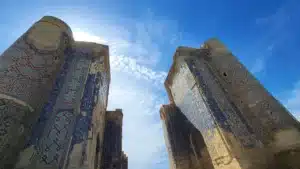
- Two colossal towers over 30 meters high (originally ~50m)
- A 22-meter-wide arch, one of the largest ever constructed in Central Asia
- Mosaic inscriptions in Kufic script, including the phrase: “The Sultan is the shadow of God on earth”
- Glazed tiles in sapphire blue, turquoise, white, and gold
The portal features spiraling mosaic ropes, dynamic geometric arabesques, and plant-inspired motifs that stretch skyward—each a masterclass in Timurid decorative art.
Symbolism and Power
Unlike Samarkand’s civic squares or religious monuments, Ak-Saray was designed to project imperial authority. It was oriented not toward the city center, but northward—facing Samarkand, symbolically connecting the ruler’s birthplace to his capital.
The name “Ak-Saray” translates not literally to “white,” but “noble,” “majestic,” or “royal.” Just as the Russian term “White Hall” denotes aristocracy, this palace was a metaphor for Timur’s divine rule.
Historian Sharaf ad-Din Ali Yazdi wrote:
“The Ak-Saray rose from the earth to rival the heavens. No eye had seen its equal since time began.”
The Fall of a Dream
After Timur’s death, the palace gradually fell into disuse. In the 16th century, it was intentionally dismantled by the Bukhara khanate to suppress the memory of the Timurid dynasty. Its ruins were used as building materials. By the 18th century, only parts of the gate remained.
During the Soviet period, efforts were made to excavate, study, and partially restore what was left. Today, the portal has been cleared and stabilized, allowing visitors to walk beneath its massive arch and admire its tilework.
Visiting Ak-Saray Today
- Location: Shahrisabz, 90 km south of Samarkand
- Best season: April–May or September–October (mild climate)
- Getting there: Scenic 2-hour drive over the Takhtakaracha Pass
- Nearby sites: Dorus Saodat Complex, Dorut Tilavat, Timur’s crypt
Final Thoughts
Ak-Saray Palace is more than a ruin—it is a testament to the vision, ambition, and artistic genius of a ruler who saw himself as king of the known world. Every tile, every arch, and every line of poetry embedded in its walls whispers of a time when Shahrisabz was destined to be the crown of an empire.
Visiting Ak-Saray isn’t just sightseeing. It’s witnessing the dream of a man who dared to rival the sky.