

Things to Do in Samarkand: Complete Guide to the Pearl of the Silk Road
Samarkand has fired the human imagination for more than two millennia. Alexander the Great called it "more beautiful than he had imagined." Timur the Great made it the capital of an empire that stretched from India to Turkey. And every traveller who stands before the Registan today leaves with the same thought: nothing could have prepared me for this.
As a local guide who has lived here my whole life, I want to show you not just the monuments you already know, but the living, breathing city around them. This guide covers everything from the iconic sights to the neighbourhood teahouses where locals actually spend their evenings.
1. Registan Square: The Heart of Samarkand
No single image is more associated with Uzbekistan than the three madrasas of Registan. The word means "sandy place" in Persian — it was the ancient city centre where merchants traded, announcements were made, and executions carried out.
The three madrasas were built across three centuries. The Ulugh Beg Madrasa (1420) is the oldest, built by the astronomer-king who calculated the year with extraordinary precision using a giant sextant. The Sher-Dor Madrasa (1636) is famous for its unusual tiger-and-deer mosaic — animalistic imagery on an Islamic building was deeply controversial. The Tilla-Kari Madrasa (1660) has a gold-covered interior ceiling that took 40 kilograms of gold leaf to create.
Practical tip: The complex opens at 8am. Come at opening time for golden light and near-empty courtyards. The evening light and light show (summer only, check locally) are equally unmissable. Entry costs around 100,000 UZS for foreigners.
2. Gur-e-Amir Mausoleum
This is the tomb of Timur (Tamerlane) himself, and it is far more intimate than you might expect. The ribbed turquoise dome visible from across the city shelters one of the great burial chambers of the Islamic world. Timur lies beneath a single dark slab of nephrite jade — the largest piece of carved jade in the world.
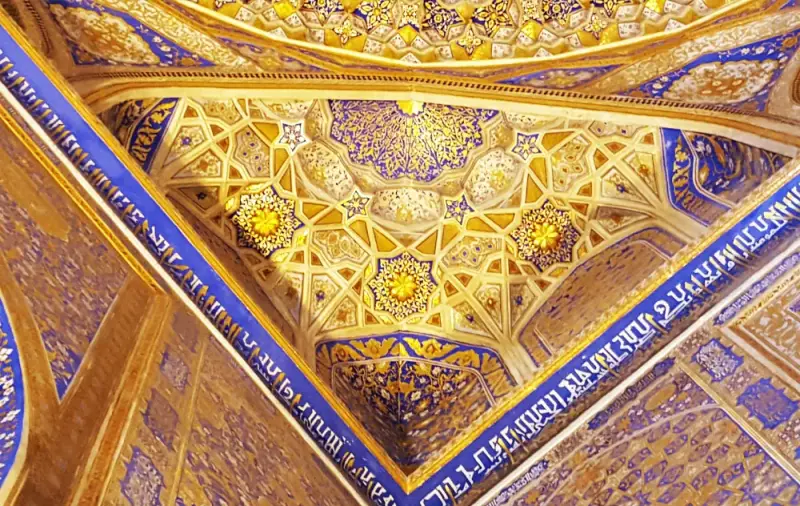
The interior is covered in the most intricate muqarnas (honeycomb vaulting) you will ever see. Legend says that when Soviet archaeologists opened Timur's tomb in June 1941, they found an inscription warning that whoever disturbs the burial will unleash a terrible war. Three days later, Germany invaded the Soviet Union.
Tip: Visit early morning or late afternoon. The light through the upper windows is extraordinary in the hour before sunset.
3. Shah-i-Zinda Necropolis
Shah-i-Zinda is, for many visitors, the most emotionally affecting site in Samarkand. A long covered stairway leads up through a sequence of mausoleums built between the 11th and 15th centuries. The tilework here is the finest in Central Asia — deep cobalt blues, turquoises and golds of impossible complexity.
The avenue contains the tombs of Timur's female relatives and court officials. It remains an active pilgrimage site. You will see local women dressed in white, pilgrims touching the carved doors, old men reciting prayers in the cool shade of the passageways.
Count the steps as you descend: there are 38. Legend says that if your count differs going up and going down, you have a sin to atone for.
4. Bibi-Khanym Mosque
Timur built this mosque for his favourite wife after returning from his Indian campaign in 1399. He wanted it to be the largest mosque in the world, and for a brief period it was. The structure was built in furious haste — workers were promised rewards to finish quickly — and began cracking even before Timur died.
What you see today is an extensive Soviet-era restoration. Stand in the vast courtyard and try to imagine this filled with 10,000 worshippers. The enormous stone Quran stand in the centre is original, a beautiful piece of craftsmanship that survived when the building crumbled around it.
5. Siab Bazaar
Behind Bibi-Khanym lies the Siab Bazaar, the oldest and most authentic market in Samarkand. Come here for the real city. Vendors sell mountains of spices, dried fruits, fresh non bread just out of clay ovens, and the famous Samarkand paper made by hand using the same technique as in the 15th century.
The non bread of Samarkand is famous across Uzbekistan. Every city has its own style, but Samarkand's round, stamped loaves with their distinctive glazed centres are considered the finest. Locals say Samarkand bread never goes stale because of the mineral content of the local water. The women who bake in the clay tandoor ovens are a masterclass in skill and speed.
6. Ulugh Beg Observatory
Most tourists skip this, and that is a mistake. Timur's grandson Ulugh Beg was one of the greatest astronomers of the pre-telescope world. In 1420 he built an observatory on a hilltop north of the city and proceeded to measure the year to within 58 seconds of the modern figure — using only his naked eye and a 40-metre sextant built into the rock.
The observatory was destroyed after his assassination in 1449, but the underground section of the giant arc instrument was rediscovered in 1908. The small museum beside it houses a clear explanation of his methods and achievements.
7. Afrosiab Museum
The hill of Afrosiab was the site of the original Samarkand, founded around 500 BC and inhabited continuously until the Mongol destruction in 1220. The museum here contains the stunning Afrosiab Frescoes, painted in the 7th century AD to decorate the throne room of a Sogdian ruler. They show ambassadors from across the ancient world bearing gifts — including figures believed to represent Turks, Indians, Chinese and even Koreans.
This is history you cannot feel anywhere else in the world. The painting is the only intact example of pre-Islamic Silk Road court art.
8. Paper Mill and Craft Workshops
The Samarkand Paper Mill at Konigil village (about 7 km outside the city) is the only place in the world still making paper using the ancient Samarkand method introduced from China in the 8th century. You can watch the entire process — from soaking mulberry bark to pressing, drying, and burnishing — and take sheets home.
The old city also has silk weaving workshops, miniature painting studios, and ceramic makers where you can watch craftsmen working and buy directly.
Day Trips from Samarkand
Samarkand makes an excellent base for exploring the wider region. Shahrisabz, 90 km south, was Timur's birthplace and contains the ruins of his enormous palace Ak-Saray — once taller than the Eiffel Tower. Urgut Bazaar and the traditional silk-weaving village of Konigil make a perfect half-day.
For a longer adventure, the Nuratau Mountains — with their walnut forests, remote Uzbek villages, and homestay guesthouses — are a two-hour drive away and feel like a different world entirely.
Practical Tips for Visiting Samarkand
- Best time to visit: April–May (spring flowers, comfortable temperatures) and September–October (harvest season, cooler weather, smaller crowds).
- Getting around: The main sites are walkable from the city centre. Taxis are cheap — agree on a price before getting in, or use Yandex taxi app.
- Dress code: Cover shoulders and knees at religious sites. Women should carry a scarf.
- Water: Drink bottled water. The tap water in Samarkand is mineral-rich and used for baking, but not recommended for drinking.
- Currency: The Uzbek sum. ATMs are common in the city centre. Most tourist sites and restaurants accept cash only.
- Time budget: Give Samarkand at minimum two full days. Three days allows you to explore properly without rushing.