

Top Things to Do in Bukhara: 2026 Guide | Jahongir Travel
Bukhara rewards a slower kind of traveller. Where other Silk Road cities dazzle with scale, Bukhara offers an intimate, remarkably preserved old town you can cross on foot in twenty minutes. This guide covers the top things to do in Bukhara from a local tour operator's perspective — what to see, what to skip, and how to experience the city beyond the standard walking route.
Why Visit Bukhara
Bukhara is over 2,500 years old — older than Samarkand as a city, and with a different character. Much of the historic centre was never flattened and rebuilt, so what you walk through today is largely authentic brickwork and tilework from the 9th to the 17th centuries. The Ismail Samani Mausoleum, built around 905 CE, is still standing and still functioning after more than 1,100 years. That continuity is rare anywhere in the world.
The second thing travellers notice is scale. Bukhara's UNESCO-listed old town is compact — you can walk from the Ark Fortress to Lyabi-Hauz in fifteen minutes, passing half a dozen major monuments on the way. Traffic is minimal in the historic centre. Tea houses and small courtyards invite you to sit; carpet shops and ceramic workshops open onto the street; and the rhythm of the day is distinctly unhurried. If Samarkand is a grand stage, Bukhara is a living room.
Top Attractions in Bukhara
Six sites account for most of what visitors experience. You can see all of them in a day on foot if you're organised.
Lyabi-Hauz Ensemble
Lyabi-Hauz ("by the pool" in Persian) is the social heart of the old town. A 17th-century stone-edged pool sits under ancient plane trees, surrounded by three monuments: Kukeldash Madrasah (one of the largest in Central Asia), Nadir Divan-Begi Khanaka (a former Sufi lodge), and Nadir Divan-Begi Madrasah, whose façade features two mythical phoenixes facing the sun — rare in Islamic iconography. Restaurants line the pool; dinner here as the lights come on is one of the quintessential Bukhara experiences.
Poi Kalyan Complex — Kalyan Minaret & Mosque
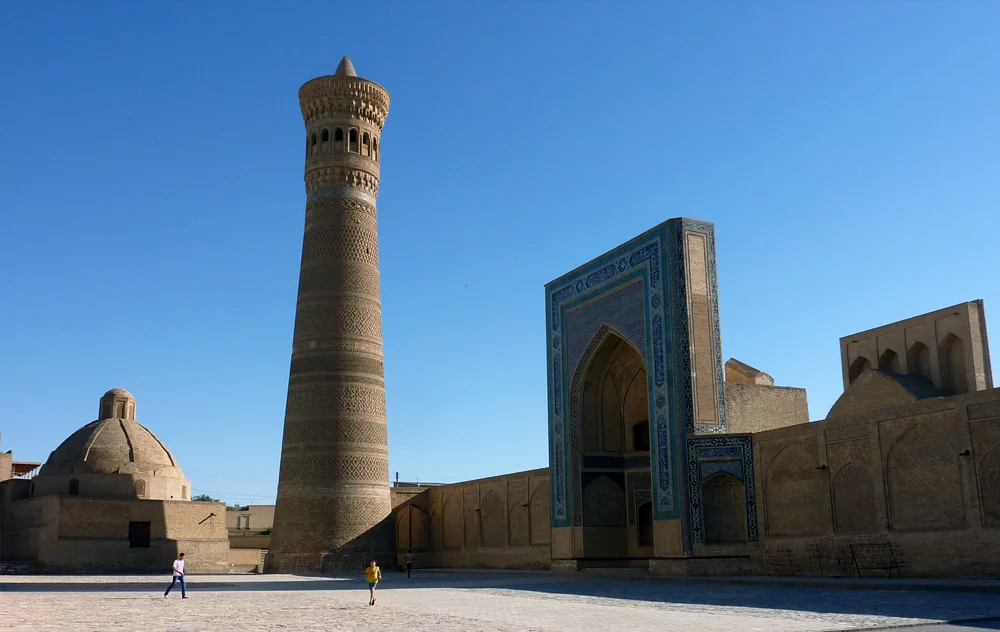
The Kalyan Minaret, built in 1127, is the signature image of Bukhara. At 47 metres it was the tallest structure in Central Asia when it was built, and Genghis Khan reportedly spared it when he destroyed the rest of the city in 1220. The Kalyan Mosque next to it was once the congregational mosque for all Bukhara — the interior courtyard holds ten thousand people. Opposite, Mir-i-Arab Madrasah is still an active religious school. The three buildings form a single plaza; go early or late for the best light.
Ark Fortress
The Ark was the emir's citadel and seat of power for over a thousand years, continuously inhabited from the 5th century until the Soviet invasion in 1920. Most of the interior was destroyed during the siege, but the 20-metre walls, the ceremonial entrance, and several surviving halls give a real sense of the scale of Bukhara's ruling court. It's the oldest continuously-occupied site in the city.
Trading Domes (Taki Markets)
Three domed covered markets — Taki-Zargaron (jewellers), Taki-Telpak Furushon (hat-makers), and Taki-Sarrafon (money-changers) — have operated on the same sites since the 16th century. Today they sell suzani embroidery, ceramics, miniature paintings, carpets, scarves, and traditional hats. The Taki markets aren't tourist kitsch: artisans still work at the back of many shops, and the crafts are genuinely produced in the region.
Chor Minor
Chor Minor ("four minarets") is a small, quirky gatehouse tucked behind the main tourist route. Built in 1807 as the entrance to a now-lost madrasah, it's a four-towered structure that resembles nothing else in Central Asia — each minaret's decoration is slightly different. You can climb to the roof for a quiet view across residential Bukhara. It's a fifteen-minute walk east of Lyabi-Hauz and worth the detour.
Bolo-Hauz Mosque
Bolo-Hauz, the "Forty Pillars" mosque, sits across from the Ark Fortress next to a reflecting pool. Despite its name, the mosque has 20 carved walnut columns — the "forty" refers to their reflection in the water, which doubles them. Built in 1712 for the emir's personal use, it was one of the few working mosques during Soviet times. Early morning light here is beautiful, and it's often empty when Lyabi-Hauz is already filling up.
If you are planning a broader visit to the city, our complete Bukhara travel guide pulls the itinerary, best time, where-to-stay and getting-around notes into one place.
Hidden Gems in Bukhara
Once you've covered the six headline sites, Bukhara rewards exploration off the main route. Ismail Samani Mausoleum, in Samanid Park north of the Ark, is the oldest surviving Islamic monument in Central Asia — its brickwork patterns still influence regional architecture a millennium later. A few steps away, Chashma-Ayub ("Job's Well") contains a spring believed to have healing properties and a small water museum.
The Jewish Quarter south of Lyabi-Hauz is another overlooked corner. Bukhara's Jewish community dates back over 2,000 years, and the Gumbaz Synagogue, built in 1620, is still active. A handful of traditional suzani workshops operate in the quieter lanes here; drop in if the doors are open — the artisans generally welcome quiet visitors.
Cultural Experiences
Beyond monuments, Bukhara offers experiences you can't find elsewhere in Uzbekistan. A visit to a traditional hammam (bathhouse) is the most distinctive — Bukhara's hammams have operated since the 16th century, heated by underground fires exactly as they were five hundred years ago. Hammam Kunjak (for women) and Hammam Bozori Kord (for men) are both authentic and easy to book through any local guide.
Tea houses along Lyabi-Hauz serve traditional green tea in handled bowls alongside non bread, dried fruit, and sometimes a pot of slow-simmered plov. Watching artisans at work — miniature painters, coppersmiths, carpet weavers — is another worthwhile pause; many workshops welcome polite visitors and don't pressure you to buy. And if you're in town on a Thursday or Saturday, a small folklore evening at Nadir Divan-Begi Madrasah features traditional music and dance in the lit courtyard.
Travel Tips for Visiting Bukhara
Walk. Bukhara is best explored on foot. The old town is about 1 km across and almost entirely free of traffic. Wear comfortable shoes — the streets are flagstone and uneven in places.
Time your day. Summer midday (June–August) exceeds 40 °C. Start early (the monuments open around 9:00), rest through the hottest hours, and resume in the late afternoon. Evenings at Lyabi-Hauz are genuinely pleasant.
Stay in the old town. A dozen small boutique hotels and B&Bs operate inside or right next to the UNESCO zone — many in converted 19th-century merchant houses. These put you within walking distance of everything and are typically better value than larger hotels in the outer city.
Allow two days if you can. One day covers the headline monuments in a fast-paced walk. Two days let you revisit key sites in different light, explore the Jewish Quarter and Ismail Samani area, and actually sit in a tea house without checking the time.
If you want the walking route planned and the historical context filled in as you go, our full-day Bukhara city tour covers all the headline sites with a local guide, transport to the outlying Ismail Samani complex, and lunch near Lyabi-Hauz.
Want a local guide to bring Bukhara to life?
Our full-day Bukhara City Tour covers Lyabi-Hauz, Poi Kalyan, the Ark Fortress, the Trading Domes and more — with historical context, walking route planning, and a relaxed pace built for the old town.
Book the Bukhara City Tour →Odil has been guiding travellers through Uzbekistan's Silk Road cities since 2009. Born in Samarkand, he specialises in cultural heritage tours, homestay experiences, and off-the-beaten-path adventures in the Nuratau Mountains. Jahongir Travel is his family-run tour operator based in Samarkand. Learn more about us.