

Registan Square Samarkand: Complete Visitor's Guide
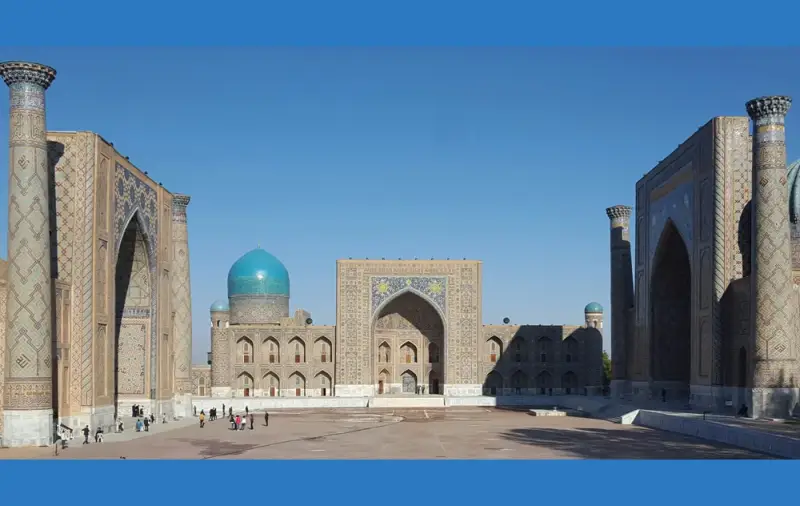
If you visit Uzbekistan and see nothing else, see the Registan. It is not hyperbole to call it one of the most beautiful man-made spaces on earth. Three madrasas from three different centuries face each other across a central square, their facades sheathed in tilework of extraordinary richness and precision. No photograph fully prepares you for the experience of standing in front of them.
I have visited the Registan hundreds of times and it still stops me. Here is everything you need to know before you go.
What Is the Registan?
The word "registan" means "sandy place" in Persian. It was the ancient public square of Samarkand — the centre of commercial, civic, and religious life for more than a thousand years. Announcements were made here, caravans departed from here, and, in less comfortable historical moments, executions took place here too.
The three madrasas you see today were built across three centuries by the rulers of Samarkand. Together they represent one of the greatest concentrations of Islamic architecture in the world.
The Three Madrasas
Ulugh Beg Madrasa (1420)
The oldest of the three was built by Timur's grandson, the astronomer-king Ulugh Beg. It was one of the most prestigious academic institutions in the Islamic world during its time — Ulugh Beg himself taught mathematics and astronomy here. The entrance portal is decorated with an astronomical motif: a sun-and-stars design that reflects the founder's passion for the sky.
Inside, the cells where students lived and studied are arranged around a courtyard. Many now house craft workshops selling Uzbek ceramics, silk, and jewellery.
Sher-Dor Madrasa (1636)
Directly opposite the Ulugh Beg, the Sher-Dor was built by the Shaybanid governor Yalangtush Bahadur. Its name means "lion-bearing" — a reference to the extraordinary mosaic above the portal showing tigers (called lions in the local tradition) chasing deer, with a sun-face rising behind them.
This imagery was deeply controversial. Islamic art traditionally prohibits representations of living beings. The Sher-Dor's creator apparently felt that the prestige of the commission outweighed theological concerns. The result is the most unusual and memorable facade in Samarkand.
Tilla-Kari Madrasa (1660)
The last of the three to be completed, Tilla-Kari served as both a madrasa and a Friday mosque. Its name means "gold-covered" — the interior of the main mosque hall is decorated with gilding so dense it seems to generate its own light. Forty kilograms of gold leaf were used.
The painted ceiling appears to have a dome, but this is a trompe-l'oeil effect — the ceiling is actually flat, and the dome is entirely painted. It is one of the most extraordinary examples of illusionistic Islamic decoration in existence.
Opening Times and Tickets
- Opening hours: Daily, approximately 8:00am–9:00pm (the square itself is always accessible; the interior buildings close earlier)
- Last entry: About 30 minutes before closing
- Ticket price: Around 100,000 UZS (approximately $8–9) for foreigners, covering entry to all three madrasas
- Note: Prices change periodically. Check current prices at the ticket office on arrival.
Best Time to Visit
Best Time of Day
Sunrise to 9am: The light is golden, the crowds are minimal, and the tilework glows. This is the best time for photography and for simply experiencing the space without tour groups. The complex opens at 8am; be there waiting.
Late afternoon (5pm–7pm): The sun moves to illuminate the Sher-Dor facade beautifully. Crowds have thinned. The colours of the tilework deepen. This is many photographers' preferred time.
Midday: Bright overhead light flattens the facades. Large tour groups arrive. Avoid if possible.
Best Season
Spring (April–May) and autumn (September–October) are ideal: comfortable temperatures, clear skies, and beautiful light. Summer (June–August) brings intense heat (35–40°C at midday) and the largest crowds. Winter visits (December–February) offer peaceful empty squares and sometimes snow on the minarets — exceptionally photogenic.
The Sound and Light Show
Each summer evening (roughly May to September), the Registan hosts a sound and light show projecting colour and historical imagery onto the facades. Shows typically start around 9:30pm and last 45 minutes.
The show is spectacular — the facades are enormous projection surfaces and the production quality has improved significantly in recent years. Tickets sell out; book in advance through your hotel or a local tour operator.
Note: the show runs on Uzbek public holidays as well, and special programmes are mounted for Navruz (March 21) and Independence Day (September 1).
Photography Tips
- Wide angle lens: The facades are very large. A 16–24mm lens (on a full-frame camera) lets you capture a full facade from inside the square.
- Drone: Drones require a permit in Uzbekistan. Check current regulations before flying.
- Interior detail: Bring a 50mm or longer lens for tilework close-ups and the Tilla-Kari ceiling.
- People in the frame: A person in traditional dress walking across the square adds scale and life. Ask before photographing individuals.
- Selfie spot: The view from the Ulugh Beg Madrasa's first-floor gallery looks across to the Tilla-Kari and Sher-Dor — one of the best angles in Central Asia.
Getting There
The Registan is in the centre of Samarkand, about 3 km from the train station. Options:
- Taxi: 10–15 minutes from anywhere in the city. Use Yandex Taxi for fixed prices.
- Walk: From most tourist hotels in the old city, 10–20 minutes on foot.
- Bus: Routes 2, 10, 14 and others pass nearby.
What to See Nearby
The Registan sits in the centre of Samarkand's historical district. Within walking distance:
- Gur-e-Amir Mausoleum (Timur's tomb) — 15 minutes' walk west
- Bibi-Khanym Mosque — 20 minutes' walk north
- Siab Bazaar — directly behind Bibi-Khanym
- Shah-i-Zinda Necropolis — 30 minutes' walk north
A full day exploring this district on foot, with time to sit and absorb each place rather than rushing through, is one of the finest days available to a traveller anywhere in Asia.