

Amir Timur: History of the World Conqueror Who Built Samarkand
Every great city has a founder. Samarkand has Amir Timur. In the second half of the 14th century, a man born in a small village near present-day Shahrisabz rose to become one of the most powerful conquerors in human history — and used that power to build the most magnificent city the medieval world had ever seen. His name was Timur ibn Taraghay Barlas. In the West he is known as Tamerlane. In Uzbekistan, he is simply the national hero.
To visit Samarkand without understanding Amir Timur is to see the stage but miss the play. The domes, the mosaics, the turquoise tilework that makes Samarkand unlike anywhere else on earth — all of it exists because of one man's will and one man's vision. This is his story.
Early Life: From Sheep Herder to Soldier
Timur was born in 1336 in the village of Kesh, near the city now called Shahrisabz (meaning "green city"), in the fertile valley south of Samarkand. His father was a minor tribal chief of the Barlas clan — a Turkic group descended from Mongol settlers who had converted to Islam and largely assimilated into the local Turkic-speaking culture.
His childhood coincided with the disintegration of the Chagatai Khanate — the successor state to Genghis Khan's empire in Central Asia. The khanate had fractured into warring factions, and young Timur grew up in a world of raids, shifting alliances, and constant violence. He learned to survive in it, and then to thrive.
According to his own accounts and those of contemporary historians, Timur received serious wounds in early raids — a sword blow to the right hand that crippled two fingers, and an arrow through the right leg that left him with a permanent limp. It is from this limp that the Western name "Tamerlane" derives: a corruption of the Persian Timur-i-Lang, meaning "Timur the Lame." He reportedly despised the epithet, but it stuck.
The Rise to Power
By his mid-thirties, Timur had emerged as the dominant military figure in the region through a combination of battlefield brilliance, ruthless elimination of rivals, and strategic marriage alliances. In 1370, he seized control of the Chagatai territories and established himself as ruler in Samarkand, though he carefully avoided claiming the title of khan — a title reserved for direct descendants of Genghis Khan. Instead, he ruled as Amir (commander) and Sahib-e-Qiran (Lord of the Auspicious Conjunction of the Planets) — a messianic title suggesting divine favour.
For the next thirty-five years, Timur launched campaign after campaign across a vast arc from Anatolia to India, from Russia to Persia. His empire at its greatest extent stretched over five million square kilometres — larger than Alexander the Great's, comparable to the Mongol Empire.
The Campaigns: Conquest on an Unprecedented Scale
Timur's military record is extraordinary in its scope and in its brutality. He did not merely defeat armies — he dismantled civilisations and rebuilt them according to his vision.
Persia and Iraq
Timur's first major foreign campaigns targeted the Persian successor states to the Ilkhanate. He conquered Khorasan, Fars, and Azerbaijan in a series of campaigns through the 1380s. When cities resisted, the consequences were severe: Isfahan revolted after surrendering and was sacked; chronicles report towers built from skulls — a deliberate psychological strategy to terrify future opponents into submission. When cities surrendered without resistance, he was often surprisingly lenient, extracting tribute and skilled craftsmen rather than destroying them.
The Golden Horde and Russia
In 1395, Timur shattered the Golden Horde — the Mongol khanate that had dominated the Russian steppe for over a century. He defeated Khan Tokhtamysh at the Battle of the Terek River, then swept north to sack Sarai, the Golden Horde's capital on the Volga. Moscow was spared only because he turned south before reaching it. The destruction of the Golden Horde removed the dominant power from the Eurasian steppe and indirectly contributed to the rise of the Muscovite state.
India: The Sack of Delhi
In 1398, Timur crossed the Hindu Kush with an army estimated at 90,000 cavalry. The Sultan of Delhi, Mahmud Tughluq, met him at the Battle of Panipat — and was utterly defeated. Delhi was sacked over several days; the city did not recover its former prosperity for nearly a century. Timur returned to Samarkand with an inconceivable quantity of loot: gems, elephants, craftsmen, and materials that would be poured into his building projects.
The Ottoman Sultanate
Timur's most spectacular single campaign was his western expedition of 1400–1402, which brought him into conflict with two of the most powerful rulers of the age simultaneously. He sacked Aleppo and Damascus, and then at the Battle of Ankara in 1402 he captured the Ottoman Sultan Bayezid I — the first time a reigning Ottoman sultan had ever been taken prisoner. The battle shocked Europe, and briefly delayed the Ottoman advance westward. Timur reportedly used Bayezid as a footrest — though historians debate whether this was fact or legend.
Samarkand: The City He Built
Between campaigns, Timur returned to Samarkand and poured his energies — and his plunder — into transforming the city. He was not merely a conqueror; he was a patron of extraordinary vision. From every conquered territory he brought back the most skilled architects, craftsmen, scholars, and artists he could find. Persian astronomers, Chinese engineers, Syrian glassmakers, Indian jewellers — all found themselves transported to the Zerafshan valley to work on Timur's city.
The results were astonishing. Contemporary observers who visited Samarkand in the early 15th century described it as the most beautiful city in the world. The Spanish ambassador Ruy González de Clavijo, who visited in 1404, wrote detailed accounts of gardens, fountains, palaces, and mosques that left him speechless with wonder.
What He Built
- Bibi-Khanym Mosque — Built to be the largest mosque in the Islamic world, constructed in just five years (1399–1404) using 95 elephants brought from India to carry building materials. Its scale was so ambitious that structural problems appeared within decades of completion.
- Registan Square — Timur created the original layout of what would become the Registan, building the Ulugh Beg Madrasah was later added by his grandson. The square was the commercial and ceremonial heart of the city.
- Shah-i-Zinda necropolis — A ceremonial avenue of mausoleums for family members and court nobles, featuring some of the finest tilework in Central Asia.
- Ak-Saray Palace in Shahrisabz — His most personal project, built in his birthplace. The entrance portal was reportedly over 65 metres tall — nothing comparable existed anywhere in the world at the time. Today only the twin towers of the portal survive, but they remain awe-inspiring.
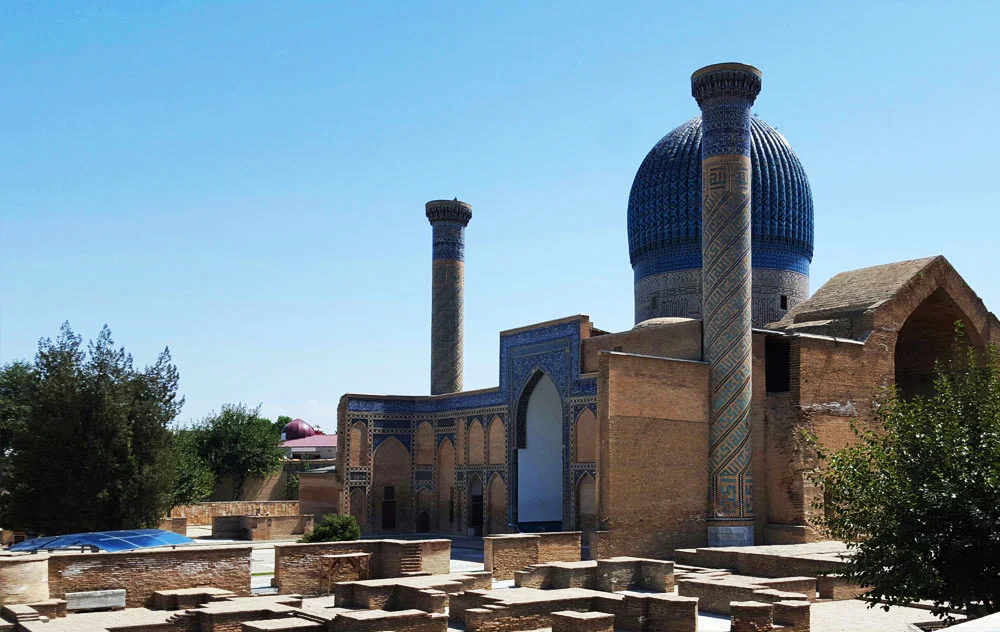
- Gur-e-Amir mausoleum — Originally built for his beloved grandson Muhammad Sultan, killed in battle in 1403, Timur himself was interred here after his death in 1405. The ribbed azure dome and intricate interior remain among the finest examples of Timurid architecture.
The Timurid Renaissance
Timur died in February 1405, at the age of 68, while leading an army towards China — his last and most ambitious campaign, cut short by illness during the crossing of the frozen Syr Darya river. He never reached his destination, but the empire he built outlasted him by more than a century.
His son Shah Rukh moved the capital to Herat (in present-day Afghanistan) but continued his father's tradition of patronage. It was Timur's grandson, Ulugh Beg, who transformed Samarkand into one of the great intellectual centres of the medieval world. A mathematician and astronomer of the first rank, Ulugh Beg built his famous observatory overlooking the city and assembled a team of scholars that produced astronomical tables of remarkable accuracy — errors of just seconds of arc in measuring stellar positions.
The Timurid period (roughly 1370–1506) produced some of the finest achievements in Persian-language literature, miniature painting, mathematics, and architecture. The school of painting that emerged in Herat under Timurid patronage influenced artistic traditions from Istanbul to Delhi. The Mughal emperors of India — descendants of Timur through Babur — carried Timurid aesthetic sensibilities to the subcontinent, where they produced the Taj Mahal.
Legacy and Reputation
No historical figure is without controversy, and Timur's legacy is deeply contested. The chronicles record enormous destruction — cities razed, populations massacred, the deliberate smashing of the irrigation systems that had sustained Central Asian agriculture for centuries. Modern historians estimate that his campaigns may have caused the deaths of 17 million people, roughly five percent of the world's population at the time.
Yet the same chronicles record his deep piety, his patronage of scholarship, his personal conversations with the philosopher Ibn Khaldun in Damascus, his extraordinary architectural legacy. He saw no contradiction between mass slaughter and the construction of paradise on earth in Samarkand. In this he was, perhaps, a man entirely of his time — and also utterly unlike anyone else in it.
In Uzbekistan today, Timur is the national symbol. His image appears on banknotes and public monuments. The central square in Tashkent is named after him. His story is taught in schools as the founding narrative of Uzbek civilisation. Whatever one makes of the moral complexity of his record, there is no question that the physical world he left behind — the domes and minarets of Samarkand, the fragments of Shahrisabz, the cultural tradition of the Timurid Renaissance — constitutes one of humanity's great artistic achievements.
The Timur Curse: Fact or Fiction?
One of the most famous stories associated with Timur's tomb is the so-called "Curse of Tamerlane." When Soviet archaeologist Mikhail Gerasimov opened the Gur-e-Amir mausoleum and exhumed Timur's body on 19 June 1941, he allegedly found an inscription inside the tomb reading: "Whoever opens my tomb shall unleash an invader more terrible than I." Three days later, on 22 June 1941, Nazi Germany invaded the Soviet Union.
The story makes for compelling reading. Historians are sceptical: no contemporary source records the inscription, and the timing may be coincidence. What is certain is that Gerasimov's examination of the skeleton confirmed Timur's physical characteristics — the leg injury, the hand wound, the robust build — and allowed him to reconstruct Timur's face with impressive accuracy. That reconstruction is displayed in the Ulugh Beg Observatory museum in Samarkand today.
Where to See Timur's Legacy in Person
The physical legacy of Amir Timur is concentrated in two cities, both easily visited from a base in Samarkand:
Samarkand
Samarkand is Timur's city above all others. The Gur-e-Amir mausoleum — where he is buried beneath a slab of dark green jade — is the most personal monument. The Shah-i-Zinda necropolis contains mausoleums for members of his family. The Bibi-Khanym Mosque, though partially ruined, still conveys the extraordinary ambition of his building programme. And the Registan, though the three madrasahs visible today were completed after his death, occupies the ceremonial space he created.
Shahrisabz
Timur's birthplace, 90 km south of Samarkand across the Zarafshan range, preserves the most personal of his projects: the Ak-Saray Palace, whose twin entrance towers still rise to over 40 metres, though the palace itself is largely gone. The Dorus-Saodat complex contains the tomb of his son Jahangir, and a crypt prepared for Timur himself — he was ultimately buried in Samarkand, but this is where he intended to rest. Our Shahrisabz day trip guide covers everything you need to know to visit independently or with a guide.
Odil has been guiding travellers through Uzbekistan's Silk Road cities since 2009. Born in Samarkand, he specialises in cultural heritage tours, homestay experiences, and off-the-beaten-path adventures in the Nuratau Mountains. Jahongir Travel is his family-run tour operator based in Samarkand. Learn more about us.