

Camel Riding in Uzbekistan: What to Expect in the Kyzylkum Desert
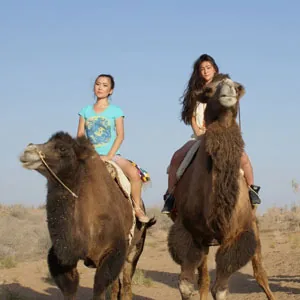
Few experiences in Central Asia are as elemental as climbing onto the back of a Bactrian camel and watching the Kyzylkum Desert unfold in every direction. No roads, no buildings — just red sand dunes, a vast salt lake on the horizon, and the slow, rhythmic sway of an animal that has been carrying travellers across this landscape for thousands of years.
Camel riding in Uzbekistan is not a theme-park activity. It is a working part of desert life, offered by nomadic families who keep their camels year-round near Aydarkul Lake. This guide covers everything you need to know before you go: which camels you'll be riding, where the best location is, what the experience actually feels like, what to wear, and how to combine it with a night in a traditional yurt camp.
Bactrian vs Dromedary: Uzbekistan's Two-Humped Camels
The camels you will ride in Uzbekistan are Bactrian camels — the two-humped species native to Central Asia. This is an important distinction. The single-humped dromedary is the camel of Arabia, North Africa, and the Indian subcontinent. When most people picture a camel, they are imagining a dromedary. The Bactrian is a different animal entirely.
Bactrian camels are built for the extreme continental climate of Central Asia: bone-dry summers where temperatures exceed 40°C, and bitter winters where they can drop to -30°C. They are larger and heavier than dromedaries, with a shaggy winter coat that they shed in great clumps each spring. Their two humps — which store fat, not water — sit upright when the animal is well-fed and begin to lean or soften when food is scarce.
In temperament, Bactrians tend to be more placid and less reactive than dromedaries. They move with a deliberate, ambling gait — both legs on the same side moving forward together — which produces the characteristic rolling, side-to-side motion that riders need a few minutes to adjust to. They are not fast animals; walking pace is around 4–6 km/h. They can be grumpy, particularly in the mornings and during the spring rutting season, and they express dissatisfaction with a rumbling gurgle and, occasionally, a well-aimed spit. Your guide will steer you clear of any animals in a difficult mood.
Where to Ride Camels in Uzbekistan
Aydarkul Lake and the Kyzylkum Desert (Best Experience)
The undisputed best location for camel riding in Uzbekistan is the area around Aydarkul Lake, on the southern edge of the Kyzylkum Desert. Aydarkul is an artificial lake created in the 1960s when Soviet irrigation canals diverted water from the Syr Darya river; it has since grown into a 3,000 km² body of water that supports flamingos, pelicans, and a surprising abundance of fish. The contrast between the shimmering lake and the surrounding desert dunes is striking.
The yurt camps near Aydarkul keep a small herd of Bactrian camels specifically for tourist rides. These animals are well-accustomed to riders and handled by local guides who have grown up with camels. The landscape here is exactly what you imagine when you picture a desert: rolling dunes of reddish-orange sand, absolute silence, and a horizon that seems impossibly wide.
Aydarkul is reached via the town of Nurata, approximately 4–5 hours from Samarkand by road. Most visitors travel as part of an organised tour, staying overnight at a yurt camp. The drive is long but passes through interesting semi-desert scenery and the old Nurata fortress, worth a short stop.
Near Bukhara
Camel rides are also available near Bukhara, at a few desert camps south of the city towards the Kyzylkum. The scenery is less dramatic than Aydarkul — flatter, with lower dunes — but the location is more convenient if you are travelling the Samarkand–Bukhara–Khiva route and want to tick the camel experience without a major detour. The yurt camp experience near Aydarkul is generally considered more authentic and more memorable.
What the Camel Riding Experience Is Like
Mounting and Dismounting
The most dramatic moments of camel riding happen before you have taken a single step. To mount, the camel is asked to kneel — it folds first its front legs, then its back legs, settling into a seated position on the ground. You climb into the saddle. Then the guide gives the signal to stand.
A camel stands back-legs-first. The animal's hindquarters come up sharply, pitching you forward at a steep angle; then the front legs straighten, and you are suddenly several metres off the ground. Hold the saddle horn firmly during both transitions. First-time riders who are not warned about this often grab the camel's neck or lose their balance. Once the animal is standing, you adjust quickly — it feels secure.
Dismounting is the same sequence in reverse: back legs fold first (you pitch backwards), then the front legs fold (you pitch forward). Again, hold on.
The Ride Itself
Once moving, the motion is unlike any other animal. The Bactrian's ambling walk — both legs on the same side moving together — creates a slow, rolling sway from side to side. It is not uncomfortable, but it is different. Most riders find their rhythm within five or ten minutes and then begin to relax enough to look at the scenery.
A typical tourist ride lasts between 30 minutes and 2 hours, depending on what you have booked. A short sunrise or sunset ride takes you to the top of the nearest dune and back — enough to feel the desert and get good photographs. A longer desert trek covers several kilometres, crosses multiple dune ridges, and gives you time to truly feel the isolation of the landscape.
The scenery around Aydarkul rewards the longer ride. From the higher dunes, you can see the lake glinting in the distance, the reed beds at its edges, and, on clear days, the faint blue smudge of the Nuratau Mountains to the south. The silence is profound — no roads, no machinery, just wind and sand.
Sunset Rides and Desert Stargazing
If you can choose your timing, ride at sunset. As the sun drops the heat eases, the light turns the dunes gold and orange, and the long shadows make for the best photographs of the trip. A short ride to the top of the nearest dune is enough to watch the sun go down over the desert.
The reward continues after dark. Far from any town or highway, the desert around Aydarkul has almost no light pollution, so on clear, cloudless nights the stars can be remarkably bright. Most camel rides here are part of an overnight yurt camp stay, which lets you stay for the campfire dinner and the night sky rather than driving back in the dark. See our Kyzylkum Desert guide for the setting.
What to Wear for Camel Riding
Dressing correctly makes the difference between a comfortable ride and a sore, sunburnt one. The desert environment is unforgiving, and the saddle creates friction that bare skin handles badly.
- Closed shoes — sandals or flip-flops will fall off and leave your feet exposed to sun and saddle straps. Trainers or hiking shoes are ideal.
- Long trousers — the saddle will chafe bare legs significantly, especially on rides longer than 30 minutes. Lightweight trekking trousers are better than jeans (too hot and too stiff).
- Sunscreen — the desert reflects UV from all angles. Apply to face, neck, and the back of your hands before you mount.
- Hat and sunglasses — a brimmed hat that ties or fits snugly is better than a cap that might blow off. Polarised sunglasses help enormously against the glare of sand and water.
- Nothing loose — scarves, unbuttoned shirts, and dangling accessories will blow into your face or catch on the saddle. Tuck everything in.
- Dark or mid-tone clothing — light-coloured clothes will show camel hair, dust, and the occasional drool stain. Wear something you don't mind getting dusty.
Combining Camel Riding with a Yurt Camp Night
The classic and most satisfying way to experience camel riding near Aydarkul is to combine it with an overnight stay at a desert yurt camp. This is what most visitors who make the long journey from Samarkand do, and it transforms the camel ride from an activity into a full immersion in nomadic desert life.
The typical itinerary runs like this: you arrive at the yurt camp in the late afternoon, after the long drive from Samarkand. The camp consists of a cluster of traditional felt yurts — round, domed structures that are cool in the heat of the day and surprisingly warm at night — set among the dunes near the lake shore. After settling in and washing off the road dust, you head out for a sunset camel ride. The late afternoon light turns the dunes gold and amber, and the lake catches the last colours of the sky. This is when the photographs happen.
After the ride, the camp gathers around a campfire in the open desert. Your hosts prepare a traditional Uzbek dinner — plov (rice cooked in lamb fat with carrots and onion), freshly baked flatbread, and salads — served under a sky that, far from any city lights, is extraordinarily dense with stars. Conversations happen in a mixture of languages; other guests at the camp are usually a mix of nationalities, drawn here by the same impulse to find something genuinely remote.
The yurts are furnished simply: low platform beds with mattresses and heavy blankets, a small table, and a wood stove for colder nights. There are no locks — this is not that kind of place. Facilities are basic but clean. The experience is about the landscape and the silence, not the amenities.
The following morning, you wake before dawn for a sunrise camel ride. The desert in the first light is a different place: cooler, the air carrying a faint smell of salt from the lake, the dunes casting long shadows in shades of pink and violet. Breakfast back at the camp — eggs, bread, jam, tea — is unhurried. Then the long drive back to Samarkand.
Guests who have stayed at the Aydarkul yurt camp consistently describe the combination of the two camel rides bookending the overnight stay as the highlight of their Uzbekistan trip. The full Uzbekistan 10-day itinerary typically includes this experience on days 5 or 6, positioned between Samarkand and Bukhara.
Practical Tips for Camel Riding in Uzbekistan
Best Season
The ideal months for desert camel riding are April–June and September–October. In spring, the desert is at its most colourful — wildflowers briefly bloom between the dunes, temperatures are warm but manageable (20–30°C), and the lake is at its highest. Autumn brings similarly pleasant temperatures and clear skies.
Avoid July and August if you can. Summer temperatures in the Kyzylkum regularly exceed 40°C, and camel riding in full afternoon heat is genuinely miserable — even the camels are reluctant. Winter (December–February) is possible but cold, with temperatures that can drop below zero at night; the landscape is stark and beautiful in its own way, but you will need serious warm clothing.
Managing the Camels
A few things to know about the animals themselves:
- Camels can be smelly. Their breath, in particular, is distinctive. This is normal and not a sign of illness.
- They are grumpiest in the morning. The camel that seemed docile yesterday afternoon may be more vocal and irritable at sunrise. Let your guide handle any reluctant animals.
- Do not approach from behind. Like most large animals, camels can kick. Always approach from the side, and wait for the guide's instruction.
- Do not feed them without asking. Camels on tourist duty are on a specific diet; unexpected food can cause digestive problems.
Photography Tips
Bring your camera, but use a wrist strap or neck strap — you need both hands free for mounting and dismounting, and a dropped camera on sand dunes is hard to recover. A wide-angle lens captures the scale of the desert well; a longer lens picks out details of the lake and distant dunes. The light at sunrise and sunset is exceptional. Midday light is harsh and flat — avoid scheduling your ride for the middle of the day if photography matters to you.
Frequently Asked Questions
Are camels in Uzbekistan safe to ride?
Yes — the Bactrian camels used for tourist rides in Uzbekistan are well-habituated to riders and handled by experienced local guides. The main challenge is the lurching motion when the camel stands up and sits down; hold the saddle horn firmly during these transitions. Children and elderly visitors ride regularly without problems.
How far is the camel riding from Samarkand?
The main camel riding area is near Aydarkul Lake in the Kyzylkum Desert, approximately 4–5 hours from Samarkand by road via the town of Nurata. Most visitors combine the camel ride with an overnight stay at a desert yurt camp, making the long drive worthwhile.
What is a Bactrian camel?
A Bactrian camel is a two-humped camel native to Central Asia. Unlike the single-humped dromedary of Arabia and North Africa, the Bactrian is adapted to the extreme temperature swings of continental deserts — freezing winters and scorching summers. They are larger and more placid than dromedaries, making them well-suited to carrying riders.
Book the Desert Yurt Camp & Camel Tour
Our Desert Yurt Camp & Camel Tour from Samarkand covers the full experience: transport to Aydarkul Lake, sunset and sunrise camel rides with an experienced local guide, overnight accommodation in a traditional yurt, and a traditional Uzbek dinner and breakfast. Everything is arranged — all you need to bring is the right clothing and a camera.
Odil has been guiding travellers through Uzbekistan's Silk Road cities since 2009. Born in Samarkand, he specialises in cultural heritage tours, homestay experiences, and off-the-beaten-path adventures in the Nuratau Mountains. Jahongir Travel is his family-run tour operator based in Samarkand. Learn more about us.