

Ak-Saray Palace: Amir Timur's Unfinished Wonder in Shahrisabz
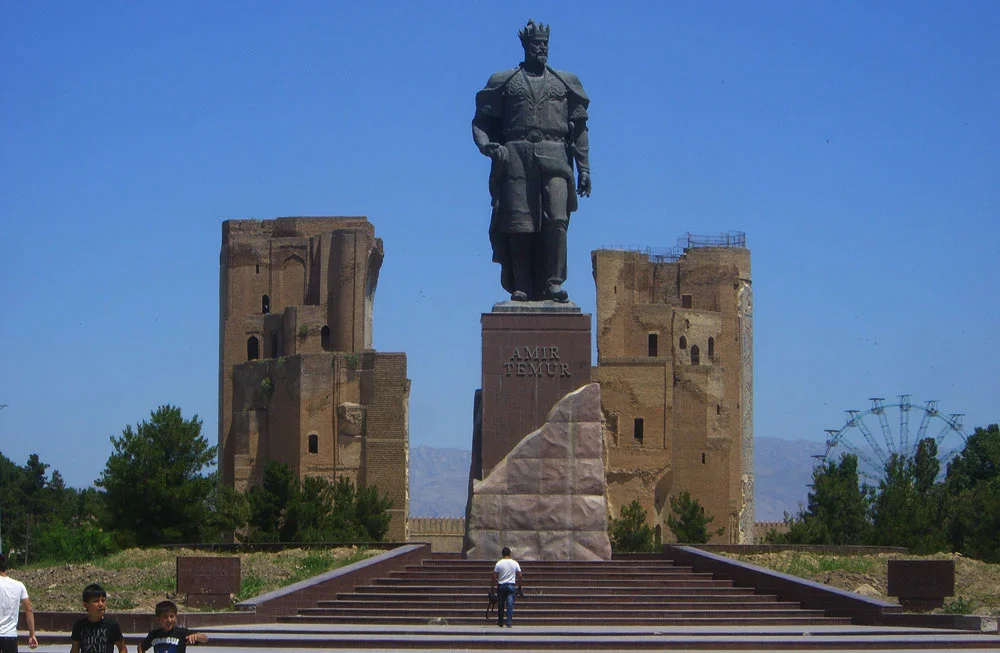
Two vast pillars of blue-tiled brickwork rise out of the centre of Shahrisabz, so tall they seem to belong to a different scale than the town around them. This is all that remains of Ak-Saray — the "White Palace" — and even in ruin it is one of the most astonishing sights in Central Asia. It was the grandest thing Amir Timur (Tamerlane) ever built, and he never lived to see it finished.
An inscription once ran across the great arch: "If you doubt our power, look at our buildings." Six hundred years later, standing beneath what survives of that gateway, the message still lands.
The Palace That Was Meant to Astonish the World
Timur was born near Shahrisabz — then called Kesh — in 1336, and he never forgot it. As his empire spread from Delhi to the gates of Damascus, he poured a share of its plunder and its captured craftsmen into turning his home town into a monument to his own power. Ak-Saray was the centrepiece: begun around 1380, it was conceived not as a cosy residence but as a ceremonial palace designed to overwhelm anyone who approached.
The numbers are hard to believe. The entrance gateway rose about 65 metres, its central arch spanning roughly 22 metres — among the widest arches ever raised in the Islamic world, and taller than almost anything standing in Europe at the time. Behind it stretched courtyards, pools and reception halls decorated in gold, marble and mosaic. Timur kept builders and tile-masters — many brought from Persia, Khorasan and India — working on it for the last twenty-four years of his life. When he died in 1405, on his way to invade China, it was still unfinished.
Want to stand under the Ak-Saray arch yourself?
Our private Shahrisabz day trip from Samarkand crosses the Tahtakaracha Pass and covers Ak-Saray, Dorut Tilavat and Kok Gumbaz with a local guide. See the tour page for current prices by party size.
Shahrisabz day trip from Samarkand → · Aman Kutan hike + Shahrisabz in one day →What Survives Today
Time was not kind to Ak-Saray. Earthquakes shook the region, and in the 16th century the Bukharan khan Abdullah Khan II is said to have deliberately dismantled the palace. What remains are the two enormous pillars of the entrance gateway, still standing to about 38 metres and separated by the gap where the great arch once sprang between them.
Walk up to their base on the modern pedestrian plaza and look closely at the surviving surfaces: bands of deep blue, turquoise and white tilework in interlocking geometric and Kufic patterns, some of it original, some carefully restored. The scale only really registers when you stand directly underneath — the people at the foot of the towers look tiny. In front of the ruins stands a bronze statue of Amir Timur, seated and gazing out over the town he wanted the world to remember him by.
The Meaning Behind the Blue Tiles
Timurid architecture used colour and scale as political language. The glazed tiles that still cling to Ak-Saray's towers were not just decoration — the sheer expense of the cobalt and turquoise glazes, and the skill of the artisans who set them, were a statement that Timur could command the finest talent from every land he had conquered. The same visual vocabulary — soaring portals, ribbed domes, star-and-polygon tile mosaics — would later reach its full flower in Samarkand, at the Bibi-Khanym Mosque and, eventually, the Registan built by his descendants.
In that sense Ak-Saray is a first draft of Samarkand's glory: the place where Timur's ambitions in stone and tile were tested at their most extreme. To understand the man behind it, it helps to read the wider story of his life and campaigns — see our guide to Amir Timur, the world conqueror who built Samarkand.
Ak-Saray in Timur's Grand Design for Shahrisabz
The palace did not stand alone. Timur intended Shahrisabz, not Samarkand, to be his final resting place, and he built a second great complex nearby — Dorus Saodat ("Seat of Power") — containing the beautiful mausoleum of his eldest son Jahangir and a crypt prepared for Timur himself. In the end he was buried in Samarkand's Gur-e-Amir instead, and the empty crypt in Shahrisabz remains one of the most poignant sights in the town. A short walk away, the Kok-Gumbaz ("Blue Dome") mosque, built by his grandson Ulugh Beg, completes the Timurid ensemble.
Seen together, Ak-Saray and its neighbours tell the story of a ruler trying to write himself into eternity through architecture — which is exactly why the whole historic centre of Shahrisabz is a UNESCO World Heritage Site.
Visiting Ak-Saray Palace Today
Ak-Saray sits at the heart of Shahrisabz, an easy walk from the town's other monuments, so a single day is plenty to see everything without rushing. The ruins are free to approach on the open plaza, and early morning or late afternoon light is best for photographs of the tilework.
- Where: central Shahrisabz, about 90 km and 1.5 hours south of Samarkand.
- Getting there: the scenic route crosses the Tahtakaracha mountain pass at 2,200 m — worth the extra half hour for the views over the Zarafshan Range.
- Combine with: the Dorus Saodat complex and the Kok-Gumbaz mosque, both a few minutes' walk from Ak-Saray.
- Guide: most site panels are only in Uzbek and Russian, so a guide adds a lot; an English-speaking guide can be arranged on request.
The simplest way to see it all is a day trip from Samarkand with a car and driver, which handles the mountain drive and lets you fit Ak-Saray, Dorus Saodat and Kok-Gumbaz into one relaxed day. For the full route, timings and what to expect, see our Shahrisabz day trip guide.
Frequently Asked Questions
How tall was Ak-Saray Palace?
Its entrance gateway once stood about 65 metres tall, with a central arch spanning roughly 22 metres — among the largest arches ever built in the Islamic world. The two surviving pillars still reach about 38 metres today.
Why is Ak-Saray Palace in ruins?
It was still unfinished when Timur died in 1405, and over the following centuries earthquakes and the deliberate destruction of the palace in the 16th century reduced it to the two great gateway pillars that survive now.
Is Ak-Saray Palace worth seeing?
Very much so. Even as a ruin it is one of the most powerful monuments in Central Asia, and because Shahrisabz sees far fewer visitors than Samarkand, you can often have it almost to yourself. Paired with the Dorus Saodat crypt and the Kok-Gumbaz mosque, it makes a rewarding day trip.
How do I get to Ak-Saray from Samarkand?
It is about 90 km and 1.5 hours south of Samarkand over the Tahtakaracha pass. A day trip from Samarkand with a car and driver is the easiest option, and lets you stop at the pass viewpoint on the way.
Odil has been guiding travellers through Uzbekistan's Silk Road cities since 2009. Born in Samarkand, he specialises in cultural heritage tours, homestay experiences, and off-the-beaten-path adventures in the Nuratau Mountains. Jahongir Travel is his family-run tour operator based in Samarkand. Learn more about us.